texts 2026
.
The Canvas as an Encounter with the Self
On Heather Allen’s Here and Now
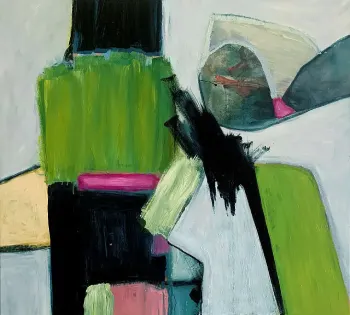
Pink Slash, 2026, oil on canvas, 90 x 100 cm
What happens when an artist begins painting without knowing what the painting will become? For Heather Allen, it begins with an openness to the present moment. She has no predetermined image in mind, no particular message she wants to convey. She follows an impulse, makes a gesture, and looks at what appears. Something now exists on the canvas that she could not have fully anticipated. She responds to it, and gradually, the painting begins to take shape.
When I first encountered Heather’s artistic practice, I was fascinated by the relationship that develops between the artist and her work. Each new mark invites her to consider what might come next. She shapes the painting, but what emerges also guides her decisions. As this dialogue unfolds, the experience of creating may reveal something she did not previously know about herself.
As a psychologist who studies creativity and as a practicing artist, I have long been interested in this relationship. We usually recognize creativity through the originality of what it produces. But what happens during the creative process may be just as important. Why should making something new help us understand ourselves? And why do we feel the urge to create in the first place?
I believe one possible answer lies in our relationship with a transcendent source of creativity. The ancient belief that humanity was created in God’s image offers an intriguing starting point. If the divine has no physical form, perhaps our resemblance lies in what we do. We create. The transcendent source brings existence into being, while we bring new possibilities into form within the world around us. The philosopher Nikolai Berdyaev understood human creativity as a free response to divine Creation. I would take this idea a step further. Our likeness to the divine is expressed not only in our ability to create, but also in our desire to do so. The human creative act begins with the urge to reenact the act of Creation.
Seen this way, creativity becomes part of what gives our existence meaning. We depend on the transcendent source for our existence, while our creative acts give its generative power a conscious presence in the material world. This relationship is not equal. The source exists independently of us, yet its creative power finds a distinctive expression through our free participation. By creating, we give form to this connection and realize something essential about our nature.
But creating something does not necessarily mean understanding ourselves. This is where authenticity becomes important. When we create authentically, we remain connected to our own experience, even when we cannot fully explain what it means. As we respond to what takes shape, we may discover feelings or possibilities that were previously unclear. Such discoveries need not be interpreted in religious terms. Yet within the philosophical perspective I am proposing, they may also reveal something about our transcendent origins. By coming to understand ourselves as creators, we may begin to understand the source of our creative nature.
Heather’s practice gives this idea a tangible presence. Once she makes a mark, she is no longer responding only to an inner impulse. There is something before her that she can see, explore, and respond to. Colors meet, forms appear, and unexpected relationships develop. Each choice changes what becomes possible next. Something that existed only as a vague possibility gradually takes shape through her actions. To me, this is where the original act of Creation finds its human expression: something new comes into being, opening possibilities that could not have been foreseen.
We can sense this process in Heather’s paintings, even though we cannot know exactly how each one developed. In Green Splash, a bold dark gesture changes how we see the colors around it. In Orange Line, a sweeping contour draws separate areas into an unexpected relationship. These paintings are very different, yet both carry a sense of discovery. Their forms seem to respond to one another, creating tensions and connections that give each work its character. What we see is the outcome of a continuing exchange between the artist and the emerging image.
This exchange is also where authenticity takes on its deeper meaning. Heather responds through her own experience and artistic sensibility. A shape or a color may resonate with her before she understands why. As she works, what began as an indistinct impulse may become more meaningful. She may recognize something in the painting that changes how she understands her initial experience. That discovery can influence her next decision, which may lead to another unexpected possibility. In this way, creating and understanding oneself become connected, each continually shaping the other.
Heather’s long experience in sculpture and installation adds another dimension to this process. In Column, painted forms seem to have weight and physical presence. The angular planes of Blue Zag suggest an architectural space. Her earlier artistic experience is still present in the way she approaches painting, but it does not dictate what she creates. Instead, it gives her a foundation from which to explore something unfamiliar. Carl Rogers considered openness to experience essential to personal growth. Heather’s willingness to follow unexpected developments reflects this openness. She allows what appears on the canvas to challenge what she already knows.
I recognize something similar in my own artistic practice. Sometimes I feel the urge to create before I understand what I want to express. Only as the work develops do I begin to recognize something of myself that I could not previously put into words. Carl Gustav Jung saw the Self as something larger than the conscious ego. His perspective helps explain why our creations can feel so familiar and yet reveal something unexpected. For me, these moments also suggest a connection with something beyond ourselves. The urge to create brings us into contact with the source of Creation, while the experience of creating may deepen our understanding of that connection.
The exhibition title, Here and Now, captures something essential about Heather’s practice. Creation begins in the present moment, with an openness to whatever may emerge. Yet this moment is never isolated. It carries the artist’s previous experiences while opening possibilities she could not have anticipated. As the painting develops, what appears before her may also change how she understands herself. In this sense, the creative encounter connects what we have been with what we might become. We bring something of ourselves into what we create, yet what we create can reveal something we did not previously understand. In this continuing encounter, the artwork takes shape, and the Self remains open to becoming.