texts 1992-97
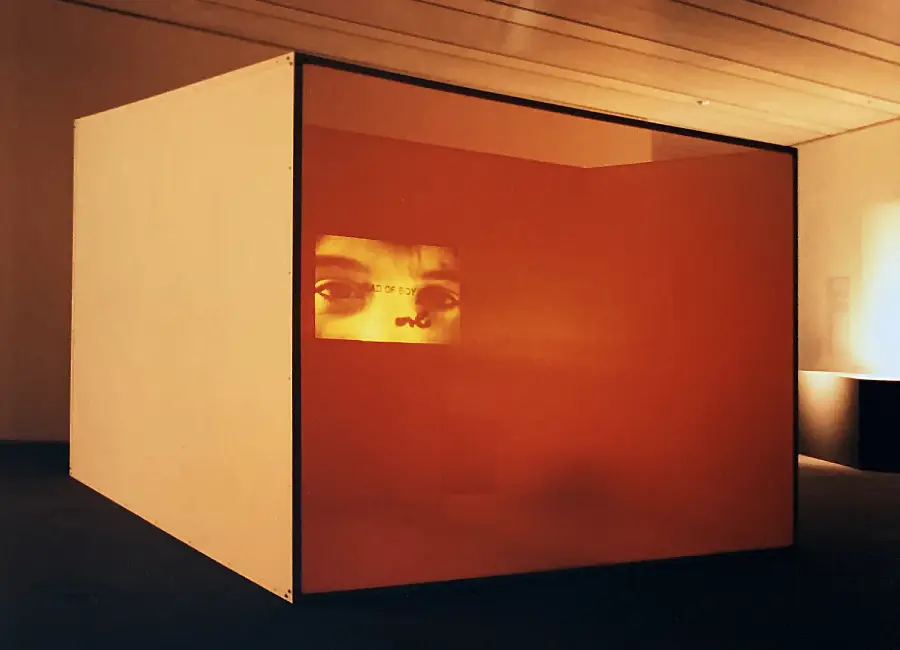
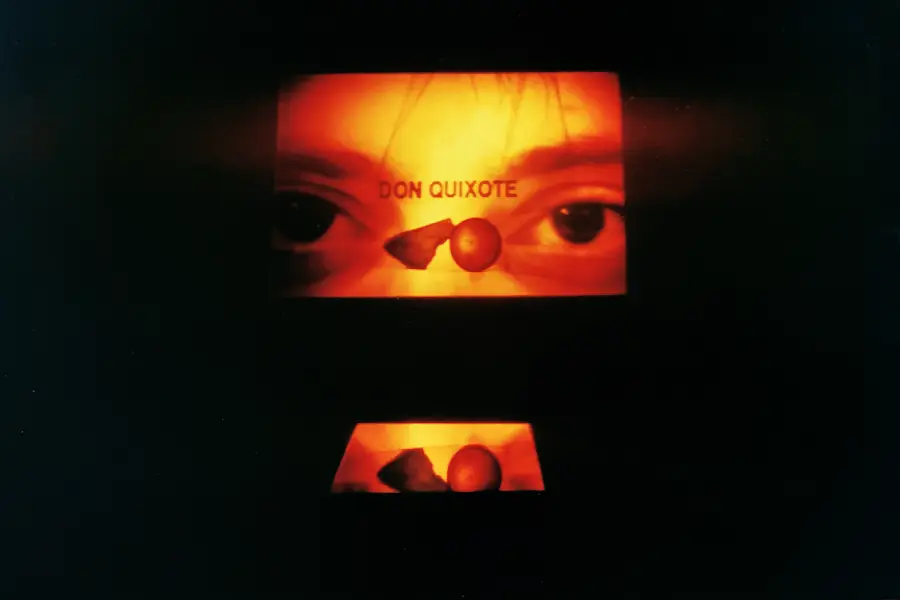
Collector’s Piece
in Collections and Reflections, Sainsbury Centre for Visual Arts, Norwich, 1997
.
Heather Allen operated as a researcher intent on structuring ideas before producing work that came very clearly and logically out of them. Heather worked from direct experience, her work grew out of her responses as a viewer, yet viewing her work is quite unlike the meandering experience of looking at art in the gallery. She has re-presented, inverted and subverted the experience, overlaid with concerns about accumulation, classification, ordering of material and the style and process of display. A period of reflection enabled her to combine prior interests, current experince and reseach, but the resultant work of art is not episodic in the same way, it has re-classified and re-contextualised an etire set of experiences and ideas.
Veronica Sekules and Les Tickle, excerpt from Collections and Reflections catalogue text, 1997
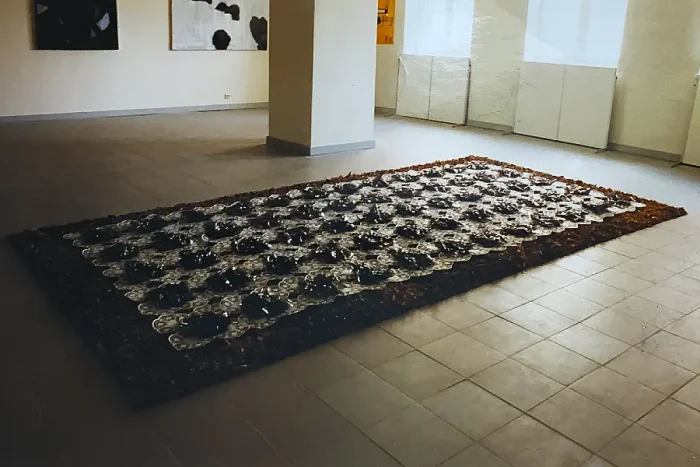
Forest Banquet, Ajaloo Institute, Tallin, Estonia, 1994
.
The Greenhouse Effect in Art Excahnge
Tallinnorwichkunstikontakt, Tallin, Estonia
(…) During July and August of this year, ten British artists came to Estonia (…) to work under local conditions, to create new work and exhibit it.
(…) Working in these conditions was not easy, forcing the artists to challenge their preconceptions and received ideas. (…). Looking at the results with at least some experience of the current British scene, it became clear that one could speak of neither common platform nor joint manifesto. (…) Perhaps more illuminating is the playfulness and relaxation of much of the work; unlike their Estonian colleages, these British artists find it easy to relax. Characteristic of this attitude is Heather Allen’s undidactic mixed media piece Forest Banquet. Untitled, her site-specific window installation in an empty house used the conventions of archeology and anthropology to present a collection of items found in situ, including bones, rusty nails and odd, unidentifiable fragments of all kinds.
Peeter Linnap, Untitled Nr. 6 Dec 1994
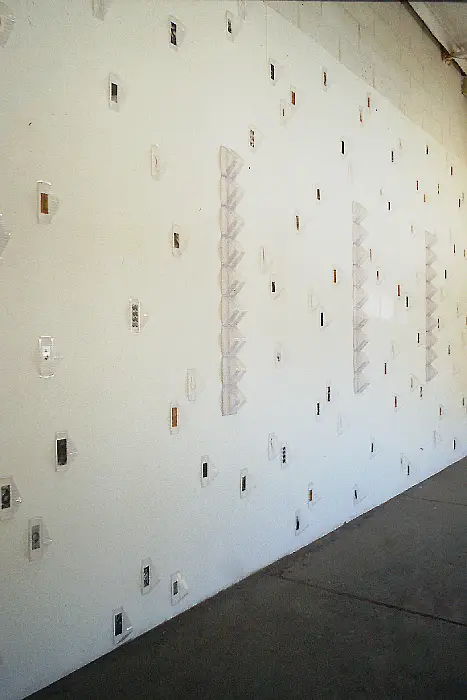
Each and Every One, King of Hearts Art Centre, Norwich, 1994
.
.
Sandwich Boxes Inspire Thought and Tranquility
Hall Gallery, King of Hearts Arts Centre, Norwich
Nowadays almost anything can be pressed into the service of art. Printmaking includes photocopies, sculpture might be from light plastic held together with wire. In some cases liberty can lead to licence, openness to thoughtless collecting.
These criticisms could never be made of Heather Allen. She is clear in her aims and severe in her means. Anything not essential to her purpose she rejects out of hand, yet even base materials are eagerly seized upon if they are the perfect vehicle for her message.
At the King of Hearts she has taken over the centre of the gallery for a wall piece. Triangular protusions act as tiny vitrines for the displays within them. These might be collections of hair, a small drawing, a photocpoied excerpt. Although arranged in a non-symmetrical manner there appears to be thought and order involved, all is tranquil… Until we realise the the plastic protrusions are sandwich containers.
No longer can such disposable objects be part of a museum. The contents are transformed into labels or identifiers of some sort. Or are they objects set to grow beneath the temporary cloches of some vertical garden? We are mystfied, and it does us good.
Behind it is an enclosed corridor lined with photocopied sheets and hanging lengths of hair.This might be a womb or memeory of childhood. It is strangely restful, not like the large charcoal drawing or a hanging perspex box, both with hidden surfaces and distrubing entrances. Heather Allen is not about to let us get too comfortable.
Tony Warner, Eastern Daily Press 8.6.1994

Membrane, Commercial Gallery, London, 1993
Heather Allen
Commercial Gallery Spitalfields, London
Much of Heather Allen’s creative concern is with the material, sisal. She is true to her material in that the sisal is allowed to take its own form rather than being subjected to manipulation and order.
Her work is, however, not simply a formalist interrogation. It has rich metaphorical meanings. The sisal shifts easily into association with hair: from the blonde fetishistic masquerade of Monroe and Madonna to the fairy tales of Old Europe and, more specifically, that of Rapunzel.
In the fairy story Rapunzel, imprisoned in a tower by a wicked witch, lets down her flowing tresses each night for her prince to climb, but she lets her secret slip and the witch cuts off her hair and banishes her, by now pregnant, to the desert. The prince climbs the golden hair as usual and is confronted – not by the object of his desire but by the witch. He escapes, but is blinded by the brambles as he falls. In the story of Rapunzel the hair is revealed to be what it is in reality, a hank of hair. In its disassociation with desire, that is the prince’s desire for Rapunzel, it no longer operates as a fetish to stimulate sexual desire, but reveals the underlying horror which men feel when confronting sexual difference, the face of the witch. Heather Allen’s work examines the tension and anxiety produced when the gap between desire and ‘reality’ is confronted. All the pieces in the show are suspended in space, the fetish is disassociated from male desire, de-eroticised, an object of dread.
In Pod, the sisal/hair has been trapped and is suspended within a hard resin outer case. This contained space can also bear metaphoric reference to the female body: which is bounded (socially, sexually and culturally) yet open to inspection, transparent to the voyeuristic or clinical gaze. In Plait, the hair has been bound/braided/constrained and domesticated. In Membrane, the hair penetrates both object and space. Heather Allen has created a paradox in which soft hair can pierce metal.The hair can be read as pubic – a form of pubic hair which penetrates rather than framing penetration. A feeling of resistance and sexual ambiguity are at plaxy.
Finally, in Out of Bounds, the hair is totally unbounded, flooding out of its container, a large, heavy, metal box. The box, with its formal reference to Minimalism has been hoisted out of the constraints of ‘normal’ gallery spectatorship. It forces the viewer to ‘see’ in a different way. The ‘hair’ takes on its own form, which is unfixed, unvoyeuristic and ‘female’.
Heather Allen uses the language of Modernism but undercuts a formal interpretation and introduces metaphorical richness. Her work also investigates how sexual difference can destabilise traditional male forms of looking, deconstructing cultural norms and proposing a radical postmodern feminist critique of high Modernism.
Dr Barbara Howey, August 1993
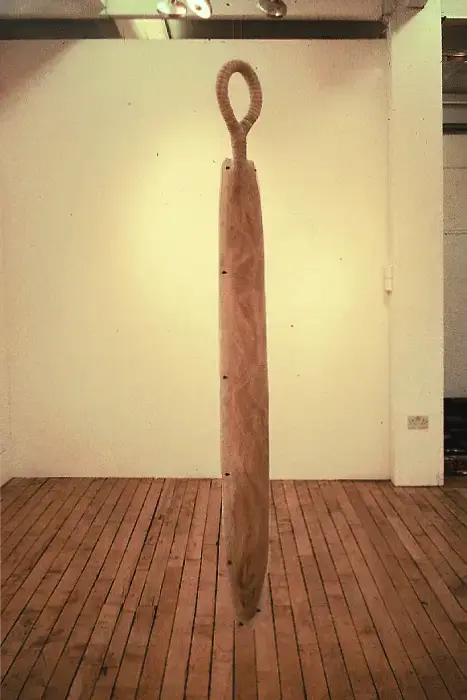
Pod, East and South, Norwich Institute of Art and Design, 1992
.
Powerful Images on Show
East and South exhibition, curated by Marjorie Althorpe-Guyton and Helen Chadwick, Norwich Institute of Art and Design
East and South at Norwich Art School is a show of power. Here are images about gender racism, imperialism, personal space. They are not only about power: they exert power. (…) Heather Allen’s 10-foot plaits, one hanging free, one sheathed, suggest not only bondage and fetishism ut also, partly by their sensitive placing ina a light, white and largely empty space, possibilities of escape.(…) They engage with much more than gender. They imply wider forms of repression.